Antoine, co-founder of Flow Exam
Antoine
Programme Grande École
Antoine, a emlyon business school MiM graduate, co-founded Flow Exam after experiencing the limitations of conventional TOEIC preparation. The platform analyses each answer, identifies precise weaknesses and creates a personalised learning path designed around the learner’s target score and available study time.
What is your academic and professional background?
I grew up in western France. After completing secondary school, I studied at Paris-Panthéon-Assas University, where I began tutoring fellow students in English. I then joined the Grande École Programme at emlyon business school through the parallel admissions route, known in France as AST. During that period, a trip to San Francisco changed the scale of my ambitions: I met entrepreneurs my own age who approached ambitious projects as if anything were possible.
I later moved into the technology sector, helping software companies use AI-powered automation to find new customers. I worked with more than 50 B2B SaaS companies, including French unicorns such as Pennylane and Spendesk. I then co-founded Flow Exam. We built the platform with an engineering team based in San Francisco and officially launched it on 19 January 2026.
I have always enjoyed building projects. At around 14, I spent my evenings teaching myself tools such as Illustrator and video-editing software, simply because I liked creating things. Three later experiences proved decisive.
- Projects during my studies: I always had a project running alongside my classes. That is where I learnt the fundamentals: finding a first customer, getting paid, making mistakes and trying again. The most substantial project was providing private English tuition to other students.
- A formative trip to San Francisco: I met 19-year-old founders with extraordinary ambition. They did not just talk about their ideas; they acted on them. I returned to France convinced that my tutoring activity addressed a real need and could be scaled.
- Experience in technology: By supporting more than 50 fast-growing companies with customer acquisition, I saw how successful teams grow. That experience gave me both practical tools and the desire to build a company of my own.
From the beginning, I have been driven by the desire to challenge myself and keep learning. I also realised early on that one of the fastest ways to learn is to speak with people who have already achieved what you want to do.
At emlyon, I turned that principle into a habit. For a year, I held three or four calls every week with school alumni, particularly entrepreneurs. I asked how they had started, what they would do differently and what they wished they had known at my age. Almost all of them made time to answer. Those conversations taught me more about entrepreneurship than any book. They also showed me that starting a company was not out of reach: these founders had sat in the same lecture halls only a few years earlier.
That is how my career direction took shape. I stopped asking myself whether I would become an entrepreneur and started asking when.
My work in technology taught me most of what I know about customer acquisition. I built automated prospecting systems at scale for software companies: identifying the right decision-makers among tens of thousands of businesses, sending the right message at the right time and turning those interactions into qualified sales meetings.
The work relied on data, connected tools and constant testing. We launched a sequence, measured the outcome, refined it and started again. Supporting more than 50 companies also showed me what separates the fastest-moving businesses from the rest: many small, practical decisions made quickly. I later applied the same principles of automation, measurement and iteration to both Flow Exam’s product and its acquisition strategy.
Key lessons from Antoine’s journey
Curiosity makes unfamiliar fields approachable. Ambition often begins by giving yourself permission to act. A sincere message and a genuine question can open valuable conversations. Finally, strong businesses execute quickly, measure outcomes and correct mistakes without ego. Academic knowledge provides the foundations; experience teaches you how to use them.
Why did you found Flow Exam?
There is a paradox that few people outside higher education know about. In France, a student can complete five years of study, pass every academic assessment, secure a first permanent job and still be unable to receive their degree because of a two-hour English test. Every year, tens of thousands of students fall only a few points short of the required score, sometimes after two or three attempts.
The challenge is different but equally demanding for students applying to leading business schools through parallel admissions. A good TOEIC score may not be enough to stand out: applicants may aim for more than 950 out of 990. I discovered that moving from 500 to 800 is often easier than progressing from 800 to 950, even though the second gap contains half as many points. At first, almost any practice produces improvement. Around 750 to 800, however, many learners reach a plateau. The final points are hidden in a small number of recurring, highly specific mistakes that must be identified individually.
Most students have no reliable record of those mistakes. They may answer hundreds of questions, check the overall score and then discard the evidence. They do not know where their weaknesses lie because nobody has measured them from the beginning. Many established tools focus on volume: the same questions for everyone, followed by a final score. It is rather like a doctor prescribing the same treatment to every patient without first making a diagnosis.
That diagnostic gap is what we wanted to address. Flow Exam tracks errors from the first question so learners can see exactly where the missing points can be gained, whether their target is 785 or 950.
While tutoring, I noticed that no two students struggled in the same place. One lost points in listening, another read too slowly, while a third repeatedly confused adverbs and pronouns without realising it. Each learner had two or three individual weaknesses. Once we focused on them, scores improved quickly. The difficulty was that no platform detected these patterns; a private tutor had to diagnose them manually.
The turning point came when I realised that I was repeating the same process for every student: recording errors, grouping them by topic and preparing targeted exercises. A well-designed platform could perform that work for thousands of learners, personalising education at scale.
I had experienced the problem myself. I completed practice test after practice test without improving, while the deadline for my degree approached. What finally helped was not doing more questions, but understanding exactly where I was losing points. Flow Exam is the tool I wish I had had at that time.
What is Flow Exam?
Flow Exam is an online TOEIC preparation platform designed in France and developed in San Francisco. It uses detailed performance data to identify each learner’s specific weaknesses and adapt their study programme in real time.
The product grew out of direct teaching experience. Before writing a single line of code, we spent more than three years tutoring approximately 500 students. That work showed us where learners genuinely struggle and what helps them improve. We then worked with highly qualified teachers who have taught TOEIC preparation for more than 20 years, building the learning methodology with them.
Finally, our San Francisco-based engineers developed the platform as a genuine technology product. We start with the data, improve the platform every week and measure what actually helps students progress. This approach allows Flow Exam to analyse every answer and continuously adapt each individual learning path.
Flow Exam addresses a straightforward need: helping learners reach their required TOEIC score within the time available. Most students are working towards a deadline, such as graduation, university admission or a work-study placement. They do not simply need to ‘study English’. They need to know exactly what to work on to gain the points they are missing.
Many e-learning platforms describe themselves as personalised, yet learners still complete broadly the same exercises in the same order. We spent more than ten months developing our own algorithm with our San Francisco team. It analyses every answer, identifies narrow areas of weakness and continually adjusts what the learner should study next.
Flow Exam at a glance
Feature | How it supports TOEIC preparation |
Granular diagnosis | Questions are classified across more than 200 detailed topics, including adverbs, prepositions, verb tenses and linking words. |
Adaptive study path | The platform prioritises exercises according to the learner’s weaknesses, objective and weekly study time. |
Detailed explanations | Corrections explain the reasoning behind the answer and why each alternative is incorrect. |
Vocabulary retention | Spaced-repetition flashcards support long-term vocabulary learning. |
Institutional dashboard | Teaching teams can identify the precise difficulties affecting a cohort and adapt their classes accordingly. |
Useful resources: online TOEIC guide | Flow Exam platform
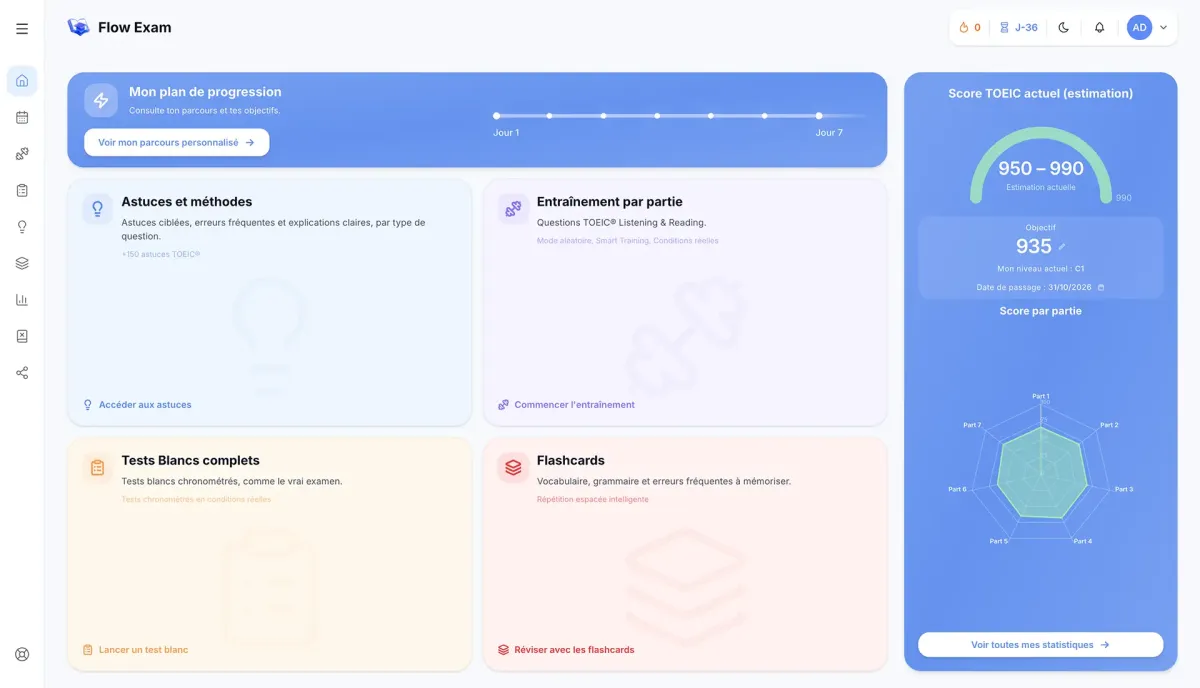
Student dashboard. The dashboard displays the estimated TOEIC score, target score, exam date and performance across all seven test sections. Learners can immediately see their current position and the next recommended activity.
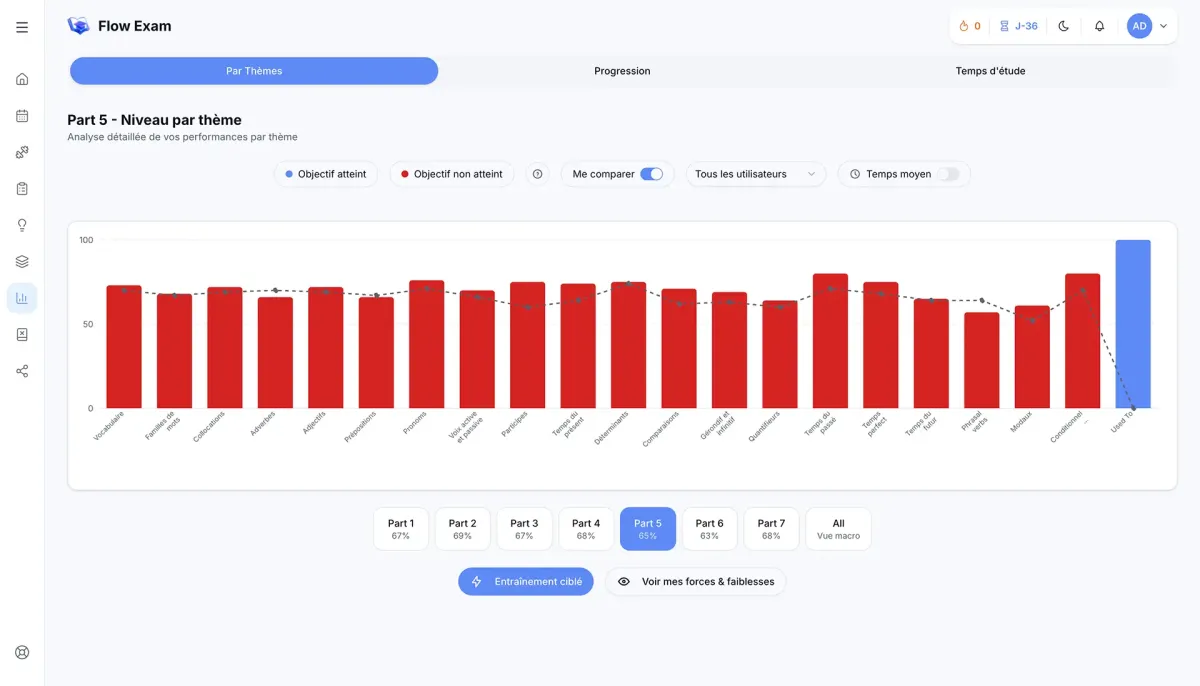
Topic-level skills analysis. For each section of the test, performance is broken down by topic. Areas requiring attention are clearly distinguished from areas already mastered, with direct access to targeted practice.
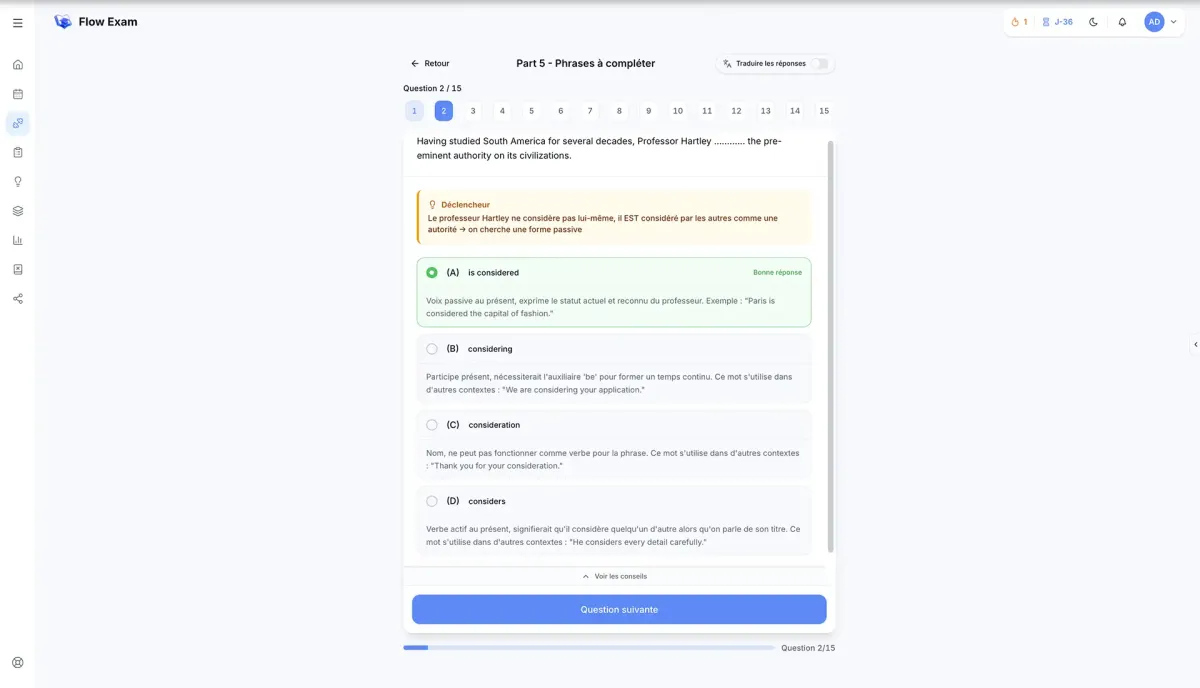
Detailed answer review. Each question is corrected in the style of a private tutor. The platform highlights the clue that should have guided the learner and explains each incorrect option with a relevant example.
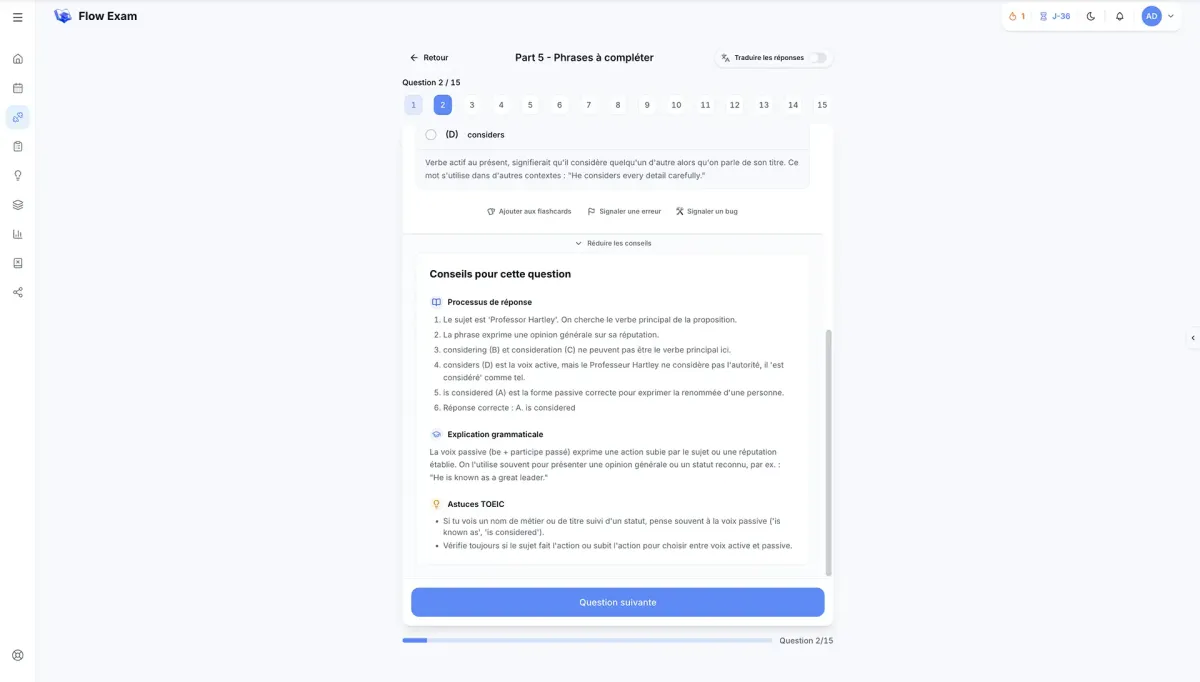
Step-by-step reasoning. Learners can open a complete explanation of the reasoning process used to reach the correct answer.
Less than a year after launch, Flow Exam is already used by students across France. Higher-education institutions, including business schools, have also chosen the platform for their student cohorts. The company’s ambition is to become a leading reference for TOEIC preparation in France, particularly within business and engineering schools, while continuing its international expansion.
Why did you choose emlyon’s Grande École Programme, and how did it support your entrepreneurial journey?
I chose emlyon for a simple reason: I wanted to build a company, and it was the school where entrepreneurship seemed most natural. Many schools discussed entrepreneurship in their brochures. At emlyon, I saw students launching projects while studying, an incubator, a makers’ lab and alumni founders throughout the French technology ecosystem.
I was not looking for a degree and then a reason to decide what to do. I wanted an environment where having a project alongside my studies would not be considered a distraction, but a valid reason for being there.
The programme gave me two things in particular. First, a supportive environment: building a company while studying is taken seriously at emlyon. Students can discuss a venture with lecturers, challenge it in class and meet peers who are launching projects of their own. Not having to progress alone changes everything.
Second, it gave me a network. emlyon alumni are present throughout the start-up ecosystem, and many doors opened with a simple message beginning, ‘I also studied at emlyon.’
A course such as Prototype at the makers’ lab, where students create a product prototype in Figma and test it rapidly with users, closely reflects how we work at Flow Exam: start small, study the data and improve. It was also a form of learning that suited me: learning by doing rather than by reciting.
What advice would you give to aspiring entrepreneurs?
The best business ideas often emerge from problems you have personally experienced. I did not discover Flow Exam by searching for a start-up idea. I found it while struggling with TOEIC preparation myself and then helping friends overcome the same challenge. When you have lived through the problem, you already understand your customers without having to imagine them.
Choosing the right co-founder also matters. My friend and business partner and I have complementary strengths. When one of us loses momentum, the other keeps things moving. I would not have sustained the same pace alone.
Everything takes longer than expected, and that is normal. When we began developing our algorithm, I thought it would take a few weeks. It took more than ten months to create something we were genuinely proud of. At the time, that felt frustrating, especially when other companies appeared to release new products every month. In retrospect, the time invested in solving one precise problem is what differentiates us today.
I wish someone had told me earlier that it is better to do one thing exceptionally well than ten things halfway, and that patience is as much a part of entrepreneurship as speed.
Antoine’s practical advice for student entrepreneurs
Start small, but start now. Sell before you build. Speak with users every week. Choose your co-founder carefully. Entrepreneurship does not require you to have been top of your class; it requires you to learn quickly, in your own way, and to try again as many times as necessary.
Frequently asked questions
Antoine is an emlyon business school alumnus and the co-founder of Flow Exam. Before launching the company, he provided English tuition and worked on AI-powered customer acquisition for more than 50 B2B SaaS businesses.
Flow Exam is an adaptive online platform for TOEIC preparation. It analyses individual answers, identifies precise weaknesses and builds a personalised study path around the learner’s target score and available time.
Rather than giving every learner the same sequence of exercises, Flow Exam classifies questions into more than 200 detailed topics and targets the areas where each student is losing points.
The platform is designed for students who need a TOEIC score for graduation, admission or a work-study opportunity, as well as higher-education institutions that want to monitor cohort progress.
The Grande École Programme gave Antoine an entrepreneurial environment, access to practical learning through the makers’ lab and connections with alumni working across the start-up ecosystem.