APHEC Congress at emlyon: championing the preparatory school–grande École pathway
By hosting the annual APHEC Congress on its Lyon campus, emlyon business school reaffirmed its commitment to the preparatory school–grande École pathway, a cornerstone of its recruitment and pedagogical model. The event was also an opportunity to unveil key evolutions of the Master in Management - Grande École, including a reform of the oral admission examination and the signing of a new dual degree with CEIBS.
A congress to reaffirm the essential role of the preparatory school–grande École pathway
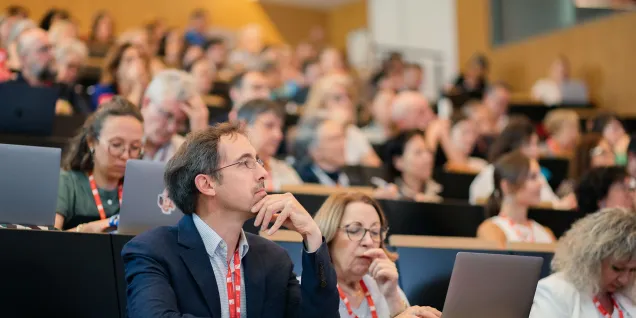
Held on the Lyon campus of emlyon business school, the annual APHEC Congress brought together nearly 200 preparatory school teachers from across France, with the aim of discovering the students' working environment and gaining insight into the School's strategic priorities, the distinctive features of its pedagogical model, and the forthcoming changes to the Master in Management - Grande École (MiM). The Association des professeurs des classes préparatoires économiques et commerciales brings together teachers from ECG and ECT preparatory streams and has maintained a longstanding dialogue with leading business schools.
Centred on the evolution and attractiveness of the preparatory pathway and its connection to the grandes écoles, the event featured institutional sessions, exchanges with the MiM academic team, and two masterclasses: one led by Anissa Pommies on the role of social sciences at emlyon, the other by Guillaume Coqueret, dedicated to artificial intelligence and quantitative finance.
It is through these moments of dialogue that we keep our model alive and evolving, in tune with students' expectations and the transformations of the world.
Hosting this congress reflects a strong conviction held by emlyon. In a higher education landscape undergoing profound transformation, where pathways into the grandes écoles are diversifying, the preparatory school–grande école pathway retains a distinctive strength. It responds, now more than ever, to the demands of a world that is more complex, more volatile, and more unpredictable.
This continuum trains not only professionals capable of taking action, but also clear-sighted and enlightened citizens, grounded in principles of humanism, the rule of law, and freedom of thought.
The preparatory school–grande École pathway directly addresses the major contemporary challenges: technological disruptions linked to AI, geopolitical tensions, economic and social transformations, environmental transition, the revolution of work, and the fragmentation of scientific pluralism. Preparatory schools provide a rigorous methodological foundation, built on intellectual rigour, analytical thinking, critical reasoning, and problem-framing skills — competencies that serve students throughout their professional and civic lives. From these foundations emerges a natural coherence with the pedagogical approaches of the grandes écoles. At emlyon, this continuity is expressed through a pedagogy centred on learning by doing, embodied in the "maker" model, and enriched by the hybridisation of knowledge. As a key driver of a multidisciplinary approach, this hybridisation is implemented through numerous strategic academic partnerships in France and internationally.
This commitment to the preparatory school model is reflected in the numbers: each year, more than 650 students from preparatory schools join the MiM — nearly 9% more than in 2021 — coming from over 177 different preparatory schools over the past five years.
This congress fully illustrates the strength of the dialogue between preparatory schools and grandes écoles: a relationship of trust, built over time, in service of academic excellence and the attractiveness of the pathway.
Landmark announcements on admissions and the evolution of the MiM
At the congress, emlyon business school presented several major evolutions of the MiM at the press conference, reflecting a clear ambition: to extend the intellectual rigour of preparatory schools through a more hybrid, more international programme, firmly anchored in contemporary challenges and underpinned by an experiential pedagogical signature.
The first landmark announcement concerns the evolution of the oral admission examination, effective from 2028. The motivation interview will be restructured into two stages: a group problem-solving exercise designed to assess candidates' maker mindset, followed by an individual personality interview based on three cards. An additional quantitative assessment, based on logico-mathematical tests, will complement the new format. The two language examinations — LV1 and LV2 — will be maintained, reflecting the importance placed on intercultural skills and international readiness.
On the academic hybridisation front, emlyon announced the signing of a new dual degree with China Europe International Business School (CEIBS), strengthening its presence in Asia and its strategy of internationalising student pathways. More broadly, the School has expanded its global academic network with new exchange agreements in Europe, Asia-Pacific, the Americas, and Africa, offering students immersive international experiences.
The School also confirmed the integration of artificial intelligence and geopolitics within the MiM — the former as a tool for mastery and critical thinking, the latter as a discipline for strategic decision-making. Finally, on the social diversity front, emlyon reaffirmed the extension of full tuition fee coverage to CROUS scholarship students at levels 4 to 7, effective from the 2026–2027 academic year.
The hybridisation of knowledge is deployed through the many academic partnerships signed by emlyon in France and internationally, including its participation in the Collège des Hautes Études Lyon Sciences (CHELS): a consortium bringing together eight institutions of excellence in the Auvergne-Rhône-Alpes region.