Finding a purpose before a career: Elisa’s journey through emlyon's MSc in Healthcare Innovation and Data Science
Elisa Anastasiou
MSc in Healthcare Innovation & Data Science
Knowing what's wrong with a healthcare system and knowing how to fix it are two very different things. Elisa Anastasiou Bountoktzi spent two years learning the first. Then she came to emlyon for the second.
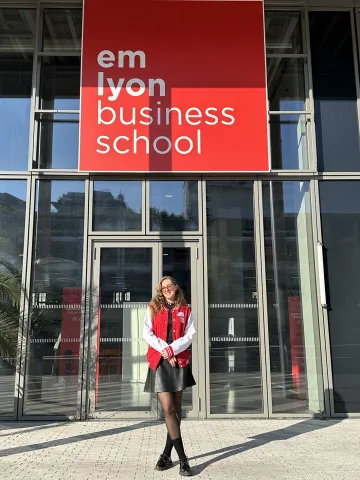
There is a particular kind of student that emlyon's MSc in Healthcare Innovation & Data Science seems to attract: not someone chasing a title, but someone chasing a problem.
For Elisa, the problem was simple to name and hard to solve. Growing up in environments where access to healthcare wasn't guaranteed shaped something in her. Not just an awareness of inequality, but what she describes as "a strong desire to contribute to society in a meaningful way." Biology came first. It was the closest path.
What pulled her in a different direction, perhaps unexpectedly, was diplomacy. Alongside her studies, she became involved in international and Model UN simulations, spending time thinking through the kinds of problems that don't get solved in a laboratory. "These experiences opened my eyes to a broader perspective: healthcare challenges are not only scientific - they are also political, economic, and societal." It's a fairly significant thing to internalize before you've finished your bachelor's degree.
Then consulting, which taught her how change happens inside complex systems.
After graduating, Elisa spent two years as a Junior Consultant working across public sector, healthcare, and humanitarian projects. She is direct about what that period did for her: "It was a turning point. It allowed me to see how real-world systems operate, how decisions are made, and how complex it is to create change at scale."
However, it also produced a particular kind of frustration. She could see the problem, but she didn’t yet have all the tools she needed to act on it. Data was reshaping healthcare faster than most institutions could follow, and she could feel the gap between her instincts and her capabilities.
A realization that both fields left her short of something essential. "Having the motivation to help was no longer enough; I needed the tools to act on it effectively. I understood that if I wanted to contribute meaningfully in today's world, I needed to develop new skills, especially in data science and innovation."
That gap - between wanting to improve healthcare and knowing how to do it with data - is exactly what the MSc in Healthcare Innovation & Data Science is designed to close.
Not starting over: building on experience to transform Healthcare
One of the most common misconceptions about specialized master's programs is that they serve students who are starting over. Elisa's trajectory tells a different story.
Her years in consulting were not a detour. They became infrastructure. She learned how organizations make decisions, where bottlenecks form, and why well-intentioned initiatives fail at scale. What she lacked was technical depth - the ability to model problems, mine data, and build evidence-based solutions.
The MSc in Healthcare Innovation & Data Science at emlyon gave her that without asking her to abandon what she already knew. Courses in data governance, health system analysis, and Python weren't taught in isolation. "What attracted me most was the program's ability to combine three dimensions that are rarely brought together so effectively: healthcare, business, and data.”, she says. They were taught in the context of real healthcare challenges, where the business logic and the human stakes were always visible.
"Concepts that I was already familiar with became more structured and more actionable."
This is perhaps the program's most underappreciated quality: it doesn't reset students’ paths. It compounds them.
Designing real healthcare solutions under real constraints
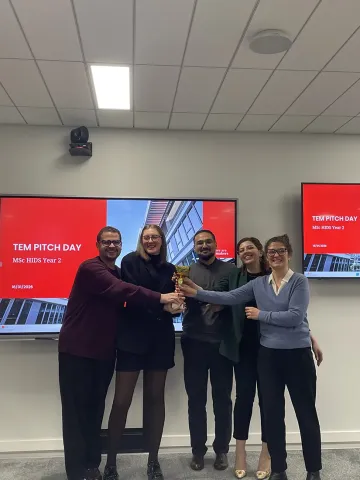
Theory finds its limits when you put it in front of a real patient population.
The Transforming Early Makers course asks students to do something that sounds straightforward until you try it: identify a real need, design a response, and build it into something viable - over several months, with a team, under genuine uncertainty.
Elisa's group turned their attention to fibromyalgia: a condition defined by chronic pain, fatigue, and a near-total lack of mainstream recognition. Patients with fibromyalgia often fall through the cracks of health systems that weren't designed with invisible illness in mind.
The team built a solution designed to make physical activity more accessible and personalized for this population, addressing not just clinical needs, but the texture of everyday life with a condition that doesn't take breaks. They won the final pitch, selected as the most realistic and impactful project of the cohort. Elisa understood what innovation actually requires. "What made this experience truly impactful was the journey: working as a team, navigating uncertainty, iterating, and pushing an idea forward despite challenges." And then, more pointedly: "Meaningful innovation starts with understanding real human needs."
In a field saturated with technology solutions searching for problems, that is not a small lesson.
Healthcare has no single map: seeing health systems across cultures
The program's international dimension deserves more than a footnote. Context is everything in healthcare.
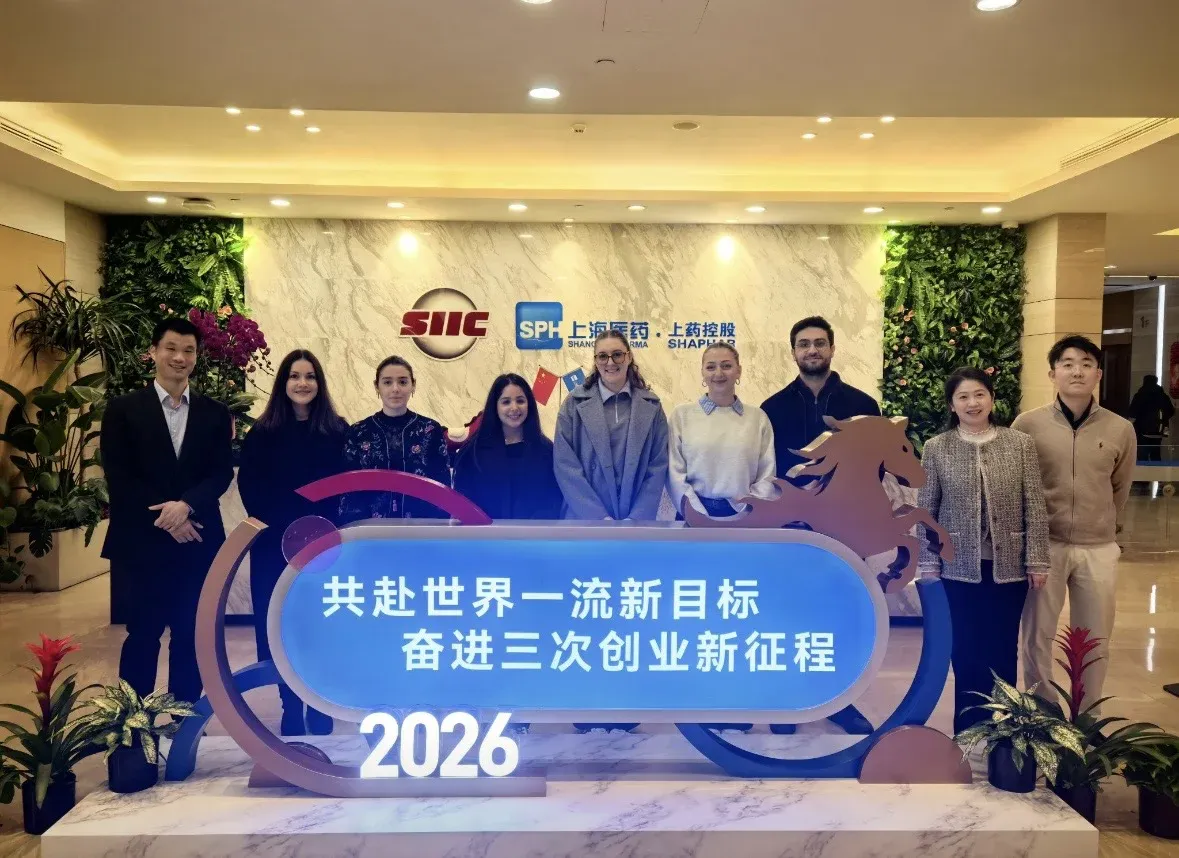
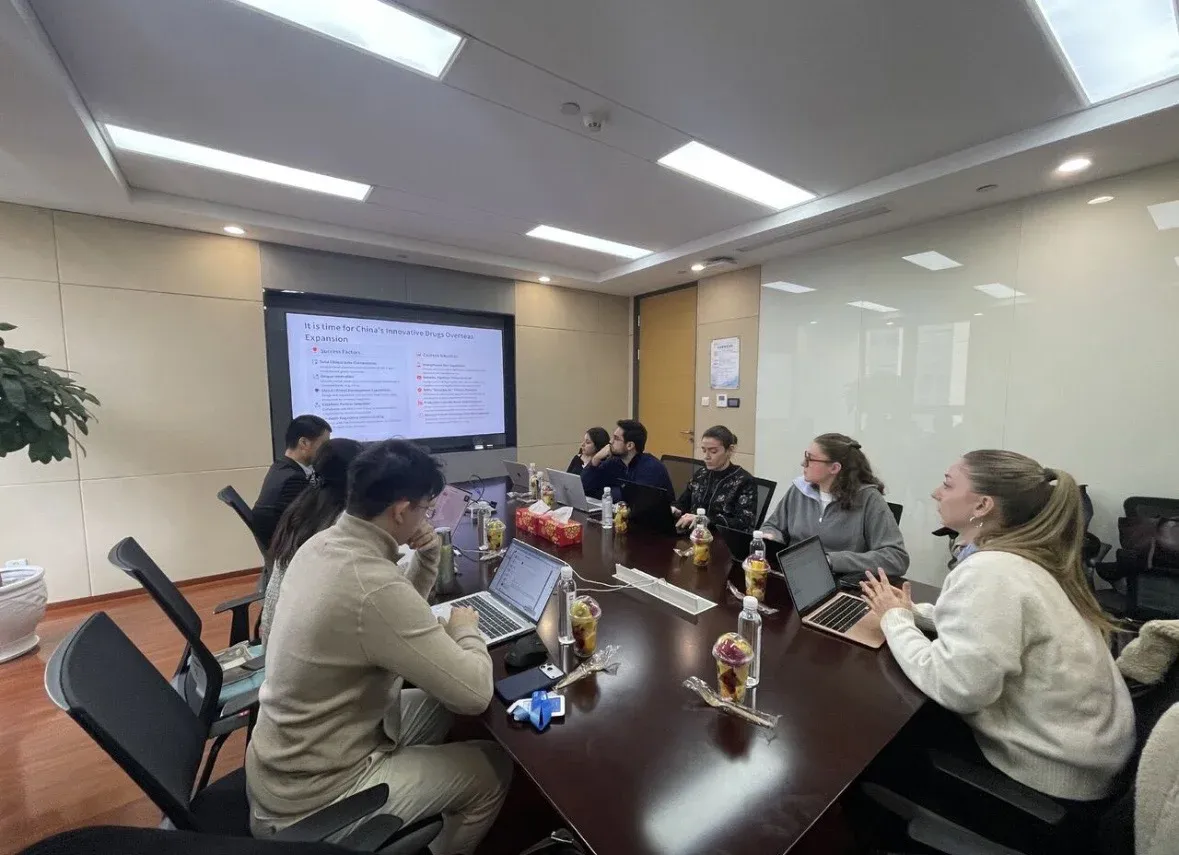
Being exposed to healthcare systems across Europe, and Asia - and particularly the immersion in China - didn't just add geographical breadth to Elisa's understanding of healthcare. It fundamentally changed how she thinks about solutions. Insurance structures, patient expectations, regulatory environments, cultural attitudes toward medicine. All of it varies, and all of it matters. "There is no universal solution. Each system reflects its own priorities, constraints, and values."
She describes that realization as "both challenging and fascinating" - which is probably the right response to discovering that most of what you thought was universal is actually local. It's unsettling in the best way. It makes you a more careful thinker, and a more useful one. For a future consultant, policy analyst, or health innovator, this is foundational knowledge.
When different backgrounds create better solutions
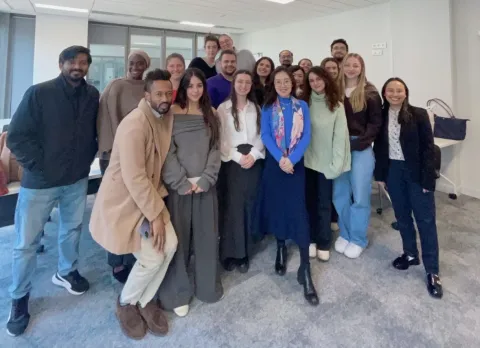
Something Elisa returns to repeatedly is the quality of the people she learned alongside. The cohort brings together students from biology, engineering, pharmacy, economics, nursing, and management - many with substantial professional experience before the program.
The friction between disciplines is not a side effect. It is a feature.
"Through these experiences, I have learned not only how to work in teams, but also how to adapt, communicate, and build on differences - skills that are essential in any professional setting."
Working through complex group projects alongside classmates who think differently is where a significant share of the real learning happens. How do you explain a financial model to a clinician? How do you translate a patient workflow problem into something a data scientist can act on? These are the skills that textbooks can describe but only practice can build.
"This diversity creates a unique learning environment where collaboration becomes a strength rather than a challenge."
The network that emerges from this cohort - cross-disciplinary, international, grounded in shared experience on hard problems - tends to stay useful long after graduation.
Broadening career possibilities in healthcare
Elisa's interests after the MSc point toward healthcare consulting and, increasingly, toward policy and global health systems - a direction she traces partly to the program's international exposure. "The program does not limit you to one path - it equips you with the tools to explore multiple directions and make informed choices."
That might be the most honest thing that can be said about a rigorous, interdisciplinary healthcare master's program: not that it guarantees a specific outcome, but that it expands the range of outcomes worth pursuing.
Is this program right for you?
The MSc in Healthcare Innovation & Data Science is intensive by design. The workload is real, the group projects are demanding, and the international immersion in Asia adds logistical complexity alongside its considerable rewards. "It is an intensive and fast-paced experience, so it requires commitment and consistency.".
But for students who are drawn to healthcare not as a background but as a calling - and who understand that today's most important health challenges are as much about data and systems as they are about science - it offers something genuinely difficult to find elsewhere: a curriculum that refuses to choose between rigor and relevance. "This program is part of a larger journey toward becoming someone who can combine science, data, and strategy to create meaningful change in healthcare. And above all, it is a way to stay aligned with what has driven me from the very beginning: the desire to give back.", she says.
Explore the MSc in Healthcare Innovation & Data Science at emlyon business school: Download the brochure or apply.
Discover more articles about the program: