Paris Energy Week: Understanding the Energy Transition in a Time of Geopolitical Tensions
Organized by emlyon business school, in collaboration with Sciences Po, Mines Paris – PSL, the Jacques Delors Institute, PSL University, Paris Dauphine – PSL, Zenon Research, Le Coq Vert – Bpifrance, and numerous international experts, Paris Energy Week has established itself as a major forum for reflection on the deep transformations of the global energy system.
Held in Paris in December, this academic and professional week brought together students, researchers, public institutions, and industry stakeholders around a shared challenge: approaching the energy transition not only as a technological issue, but also as a major geopolitical, industrial, and economic phenomenon.
A week to unpack new energy fault lines
In a context shaped by the post-COP30 period in Belém, rising trade tensions, and shifting global power dynamics, Paris Energy Week offered a systemic perspective on the energy transition. Discussions brought together climate challenges, energy security, industrial sovereignty, and technological innovation, while accounting for rapid changes driven by electrification, artificial intelligence, and the digitalization of economies.
The event’s ambition was clear: to provide participants with a concrete understanding of the forces at work, closely connected to political and industrial decision-making, while also questioning the ability of current models to meet European and global climate goals.
Energy geopolitics at the center of the discussions
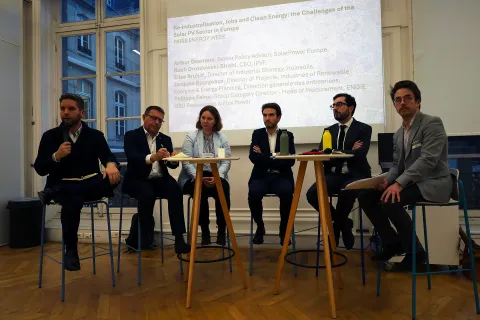
The first day, hosted at Sciences Po, set the tone with a session dedicated to energy geopolitics, moderated by Thibaud Voïta (emlyon business school, Jacques Delors Institute). The panel brought together experts from research, strategic consulting, and diplomacy, including Michal Meidan (Oxford Institute for Energy Studies and Sciences Po), Henning Gloystein (Eurasia Group), and Pedro Brancante (Brazilian Embassy in Paris). The session was followed by the launch of one of the sector’s most influential reports, the World Energy Outlook, presented by Tim Gould of the International Energy Agency.
The discussions highlighted a now-unavoidable reality: the energy transition depends on highly concentrated supply chains, particularly for critical minerals essential to low-carbon technologies. Lithium, cobalt, and nickel have become strategic resources (much like oil and gas in the past) exposing European economies to new forms of dependency.
Between climate ambitions and industrial realities
The conversations underscored the paradox facing governments and companies alike. On the one hand, accelerating electrification and the expansion of electric vehicles, batteries, and digital infrastructure are placing growing pressure on demand for raw materials and electricity. On the other hand, mining, refining, and recycling capacities are struggling to keep pace, especially in Europe, where high energy costs and regulatory constraints slow investment.
Projections shared during the presentation of the IEA’s World Energy Outlook illustrated the scale of the challenge: global electricity demand could increase by nearly 10,000 TWh by 2035, while some regions continue to expand fossil fuel production to secure economic growth. This tension between energy security, industrial competitiveness, and climate objectives ran throughout the discussions.
A transition that has become a field of strategic rivalry
As discussions progressed, one conclusion became clear: the energy transition has evolved into a space of geopolitical rivalry. China’s dominance in critical minerals, export control strategies, the rise of new producer countries, and the determination of major consumers such as the European Union and the United States to reduce their dependencies are reshaping global power balances.
The conversations moved beyond a binary framing of the issue. While resource concentration represents a significant risk, it also creates opportunities for cooperation, particularly with countries such as Brazil that seek to position themselves within more sustainable and diversified value chains. The energy transition thus emerges as a constant arena of negotiation among states, industrial players, and financial institutions, where political choices directly shape technological trajectories.
Still-fragile levers for action
In response to these challenges, several avenues were discussed throughout the week: partial reshoring of refining activities, the development of closed-loop recycling, international strategic partnerships, and stronger integration of ESG criteria into industrial decision-making. At the same time, Paris Energy Week highlighted the current limitations of these approaches, notably high investment costs, long implementation timelines, and intensified global competition.
The central question remains whether Europe can reconcile climate ambition with industrial sovereignty without creating new structural dependencies.
A learning environment grounded in real-world dynamics
For students in emlyon’s MSc in Management of Energy Transitions, Paris Energy Week served as a true educational laboratory. As Ajay Kumar Maheshh notes, the event makes it possible to connect theoretical frameworks taught in the classroom with real-world realities through direct exchanges with experts, researchers, and public decision-makers.
This immersion supports the development of key skills—strategic analysis, understanding energy policy, communication, and networking—while preparing students to operate in a sector where political, industrial, and financial dimensions are inseparable.
Training the decision-makers of the energy transition
By bringing together academic expertise, leading institutions, and economic actors, Paris Energy Week reflects emlyon business school’s ambition to train leaders capable of navigating the complexity of the global energy transition. More than an event, it stands as a space for collective reflection, where the contours of a future energy system shaped by decisive strategic choices are beginning to take shape.