Financial Times: emlyon’s Master in Finance ranked 11th worldwide
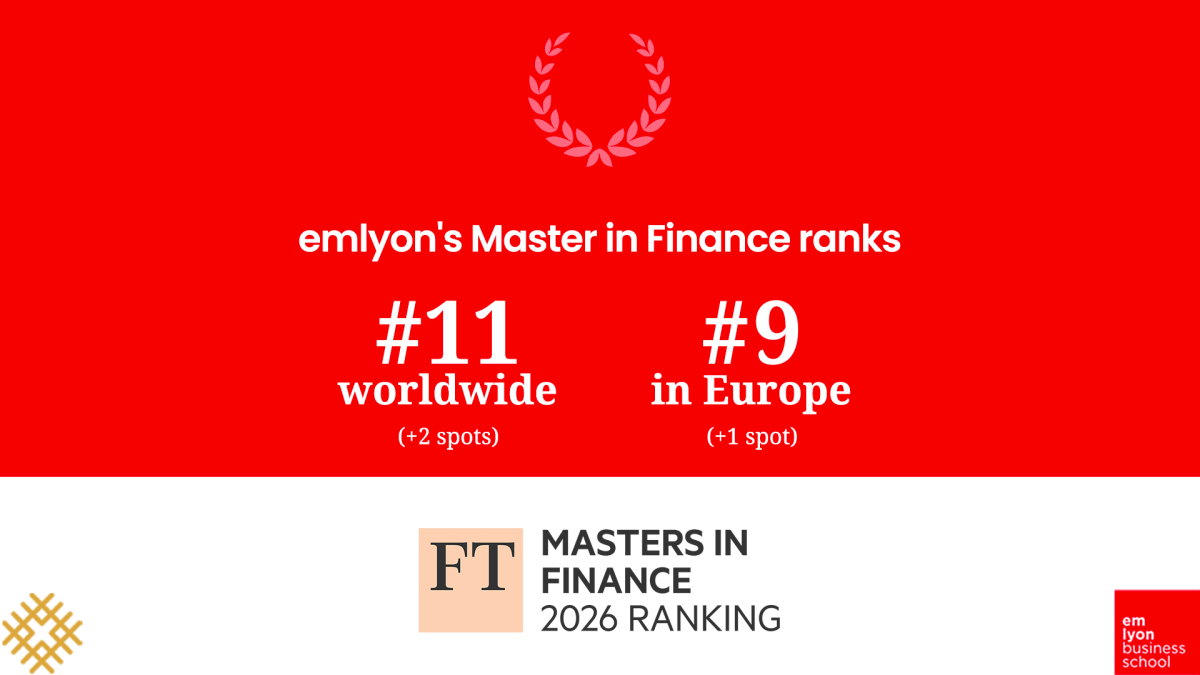
emlyon business school’s Master in Finance stands out in the 2026 Financial Times Ranking, reaching 11th place worldwide: up two positions compared to 2025. The program also confirms its strong performance in Europe and in France.
emlyon rises in the Financial Times global ranking
In the 2026 edition of the Financial Times Masters in Finance Ranking, emlyon’s MSc in Finance ranks 11th worldwide (+2 places compared to 2025), among more than 70 schools evaluated, marking its best position to date. The program also reaches 9th place in Europe, gaining one place year-on-year, and maintains its 6th position in France.
This top 20 global progression is driven by excellent results across several key indicators, reflecting graduates’ career success, salary outcomes, and overall satisfaction.
Among the strongest-performing criteria:
- Salary three years after graduation:
$130K on average - Salary increase: 4th in France
+63% three years after graduation - Aims achieved: joint 7th worldwide, joint 6th in Europe and joint 3rd in France
- Overall alumni satisfaction: 4th in France. Score of 9.21/10
- ESG & Net Zero teaching: 7th worldwide, 7th in Europe and 4th in France
This latest progression reflects the program’s continuous investment in both pedagogy and academic excellence. It also recognises our ability to prepare and support our students, in close collaboration with the Career center and the alumni network, so that they can seize the best professional opportunities. Finally, it demonstrates our agility and our capacity to anticipate the transformations shaping careers in finance, by positioning the program at the heart of a particularly demanding academic and professional ecosystem.
Methodology:
The Financial Times Master in Finance ranking is based 56% on a survey of alumni three years after graduation and 44% on data provided by participating schools. It evaluates programs using 19 weighted criteria, including salary and salary progression, achievement of study objectives, alumni satisfaction, and the integration of ESG and climate-related topics into the curriculum.