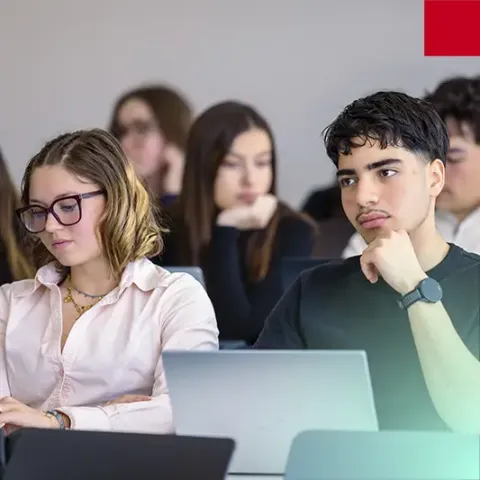
emlyon tech school teaching model
emlyon tech school, a new school model to educate the future leaders of technology
Technology is evolving constantly. Jobs are being transformed, new uses are emerging, and organizations must learn how to make decisions in uncertain environments.
To prepare students for these realities, emlyon tech school has developed a teaching model built on action, experimentation, and responsibility. Academic knowledge is never separated from practical application: it becomes a tool for understanding, designing, testing, deciding, and driving transformation. Students develop dual depth: a strong foundation in mathematics, computer science, and artificial intelligence, combined with expertise in business, management, and the social sciences.
Our teaching model is built on three pillars: the maker mindset, responsible technology, and academic excellence.
Our Teaching Model
The Maker Mindset: Learning by Doing, Doing by Learning
Inspired by the maker movement, emlyon tech school places experimentation at the heart of learning. Students learn by designing, testing, and refining solutions to real-world challenges. Projects, hackathons, prototyping sprints, company missions, and hands-on experiences in the Makers’ Labs shape their learning journey. The goal is not simply to acquire knowledge, but to develop the ability to apply it to take action, collaborate effectively, and solve complex problems.
Tech for Good by Design: Responsibility at the Core of Decision-Making
Every innovation generates impacts that extend beyond technical performance alone.
At emlyon tech school, students learn to assess the economic, social, and environmental implications of technology in order to make informed decisions. Ethical, sustainability, and governance considerations are embedded across all programs and treated as integral dimensions of innovation. In every project, a Resonance Report examines the human, societal, and environmental effects of the technology being developed.
A Teaching Model Fueled by Research
Our programs draw on the research conducted by emlyon’s faculty and researchers in management, technology, data science, artificial intelligence, and the social sciences.This close connection to research enables students to develop a deep understanding of technological transformations, combined with critical thinking and strong analytical rigor.
The Signature Teaching Model of emlyon tech school
At emlyon tech school, learning is built around continuous immersion in real-world situations, with projects serving as the foundation of the entire student experience. Each project follows one of the School’s signature formats, while teaching modules are designed to ensure that students apply their academic learning directly to the challenges they tackle.
Every project begins with a real-world problem provided by a partner company or research laboratory. Students explore opportunities, experiment with solutions, analyze data, make decisions, design recommendations, and defend their proposals. This approach enables them to connect technology, strategy, and transformation while developing the skills, methods, and mindset needed to thrive in rapidly evolving environments.
Because technology careers are constantly changing, students are prepared to take on a wide range of roles. They develop the adaptability required to navigate technological and organizational transformations throughout their professional lives.
Capabilities Developed
Turn scientific and technological advances into drivers of value creation.
Move from prototype to deployment and industrialization while addressing implementation, governance, and adoption challenges.
Translate technical challenges for business stakeholders, balance competing priorities, and align decision-making across diverse teams.
Integrate ethical, societal, and environmental considerations into technology design from the outset.
Signature learning formats at emlyon tech school
As part of the Tech Monitor, students identify emerging technologies, assess their maturity, and evaluate opportunities and risks to help organizations make informed strategic decisions.
Typical challenge: What is the current state, future trajectory, and potential impact of a technological field?
Key skills: technology intelligence, strategic foresight, technology assessment, and decision support.
An intensive and immersive experience in which students bring ideas to life by developing functional solutions under conditions similar to those found in professional environments.
Typical challenge: How can a functional prototype be delivered within a highly constrained timeframe?
Key skills: rapid prototyping, execution under pressure, teamwork, and constraint management.
Using real-world data provided by a partner organization, students analyze user behavior and evaluate live systems to uncover the gap between design intentions and actual usage.
Typical challenge: How is a technology system actually being used?
Key skills: data analysis, user behavior insights, and system performance evaluation.
How do you structure and arbitrate a high-stakes technology decision? In this format, students combine data, analysis, operational constraints, and strategic criteria to formulate and defend a recommendation.
Typical challenge: Should this technology system be built, purchased, or abandoned, and based on which criteria?
Key skills: decision-making, trade-off analysis, risk assessment, and technology governance.
Through Tech to Market projects, students explore user needs, market opportunities, positioning strategies, and the economic potential of a technology in order to accelerate its path to adoption and commercialization.
Typical challenge: How can a technology be transformed into a compelling value proposition?
Key skills: innovation management, technology marketing, market analysis, and business model design.
Through this analytical framework, students step back from purely technical considerations to examine the broader transformations technology creates within organizations and society. The Resonance Report complements technical approaches by exploring the human, cultural, social, and environmental consequences of innovation. It is embedded across all project formats within the programs.
Typical challenge: What effects does this system create, for whom, and under what conditions?
Key skills: critical thinking, societal analysis, ethics, and responsible innovation.
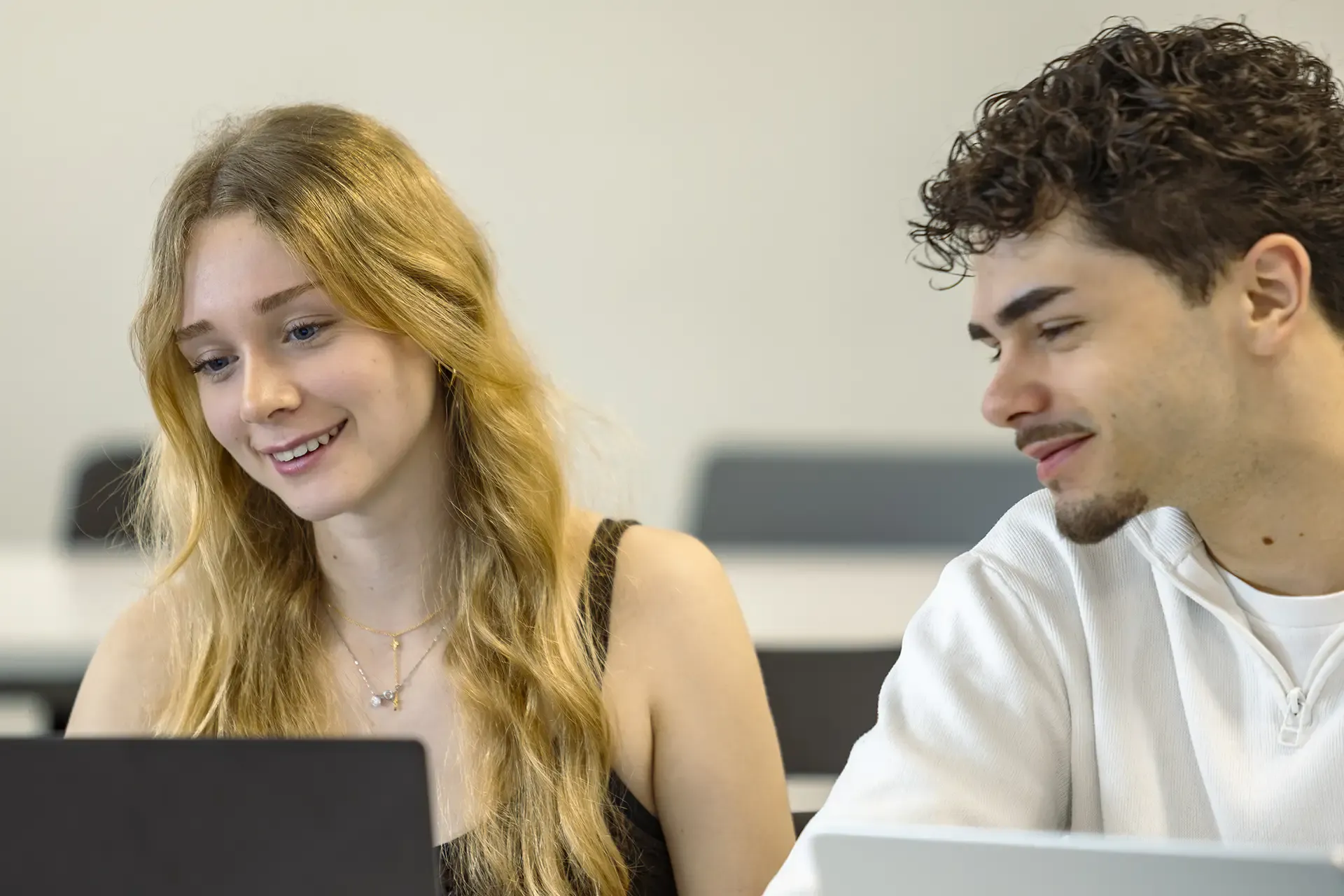
From the Makers’ Labs to organizations: learning through action
Makers’ Labs, collaborative projects, challenges set by partner companies, and immersive experiences provide opportunities to put knowledge to the test in real-world contexts.
At emlyon tech school, students learn to design, experiment, analyze, and make decisions in environments that closely reflect those they will encounter in their future careers. Understanding technology is not enough: they must also learn how to transform it into concrete solutions, create value, and generate meaningful impact.